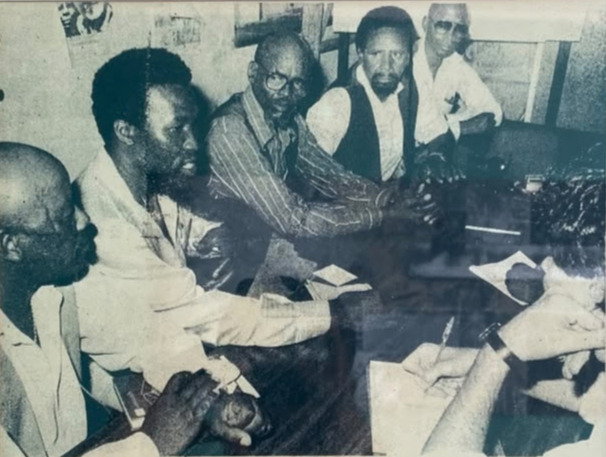
In the post-apartheid era, the family members of the PEBCO Three victims have steadfastly pursued justice for their loved ones, refusing to let their sacrifices be forgotten. Their unwavering commitment to seeking accountability and closure has taken them through a labyrinthine legal process and enduring the emotional toll of revisiting painful memories. They have been at the forefront of advocating for the full disclosure of the truth, demanding accountability from those responsible, and calling for a reckoning with South Africa’s troubled past. Through their courage and determination, these family members have not only honoured the memory of the PEBCO Three but have also contributed to the broader national dialogue on reconciliation, justice, and healing in post-apartheid South Africa. Their pursuit of justice serves as a poignant reminder that the fight for a just and equitable society is a continuous journey, one that endures long after the darkest days of apartheid have passed.
The TRC held the promise that those crimes that were not granted amnesty would be investigated and prosecuted by the policing and prosecuting authorities of the democratic government. The PEBCO 3 case was the first case that the Priority Crimes Litigation Unit (PCLU) of the National Prosecuting Authority (NPA) pursued in respect of perpetrators who had been refused amnesty. On 11 February 2004, Nieuwoudt, Van Zyl, and Koole were charged with the 1985 kidnapping, assault and murder of Hashe, Godolozi, and Galela. This was the first case that the Priority Crimes Litigation Unit (PCLU) of the National Prosecuting Authority (NPA) had pursued in respect of perpetrators who had been refused amnesty. However, shortly after their bail hearings in 2004, Nieuwoudt and Van Zyl applied to the High Court for a review of the Amnesty Committee’s decision. The Court ruled that another amnesty committee should be convened to rehear the application. As a result, the case was provisionally withdrawn against the security police officers. The NPA submitted that the prosecution could not proceed pending the amnesty decision. The amnesty committee was never reconvened, and the case effectively stalled
In August 2007, the remains of five persons were exhumed by the NPA’s Missing Persons Task Team (MTT) in Post Chalmers, Eastern Cape. The remains were believed to include the PEBCO Three, though this stands in conflict with evidence given to the TRC by the Security Branch officers involved who had claimed that the bodies were thrown into the Fish River by Nieuwoudt the following day. No DNA testing was undertaken on the remains. On 12 September 2009, the Minister of Justice formally handed over the remains to the families.
Between 2011 and 2019, the PEBCO Three docket was held by the PCLU at the NPA’s Head Office. At that time, at least five known perpetrators implicated in the murders were still alive, however, no further investigative or prosecutorial steps were taken. In 2019, the PEBCO Three families, supported by the Foundation for Human Rights, formally requested the NPA and DPCI to reopen the case.
On 1 December 2023, the families’ legal team handed over a detailed analysis of the evidence to the NPA, calling for criminal charges to be brought against the last three surviving suspects: former Vlakplaas members Colonel Roelof Jacobus Venter (aged 75), Warrant Officer Gerhardus Cornelius Beeslaar (aged 85), and askari Joe Mamasela (aged 70). The lawyers implored the NPA to act expeditiously, given the advanced ages of the suspects. Mr Venter died in July 2024, and Mr Beeslaar in April 2026, leaving Mr Mamasela as the only surviving perpetrator known to have been involved in the murder of the PEBCO Three.
Further engagements followed, but it was only in the first quarter of 2025 that the NPA made it clear they would not proceed with prosecution and in July 2025 decided to proceed with an inquest instead.
Inquest into the PEBCO Three Case 2025
Despite repeated efforts by the families’ lawyers to schedule a meeting with the NPA to obtain a decision on prosecution, such a meeting only took place in December 2024. Further engagements followed, but it was only in the first quarter of 2025 that the NPA made it clear they would not proceed with prosecution. The families accepted that, at this stage, an inquest would be the only feasible option.
In July 2025, The Minister of Justice and Constitutional Development approved the National Director of Public Prosecutions’ (NDPP) request for the holding of a joint inquest into the deaths of Hashe, Godolozi and Galela, to be held at the Eastern Cape Division of the High Court, Gqeberha. The NDPP’s request was based on the recommendations of the Eastern Cape Director of Public Prosecutions, Barry Madolo.
The first sitting of the inquest is scheduled to be heard from 12 to 16 October 2026.